How to Optimize Your Business Website for Google Search
 By Eamp
2026-06-17
0 Comments
By Eamp
2026-06-17
0 Comments
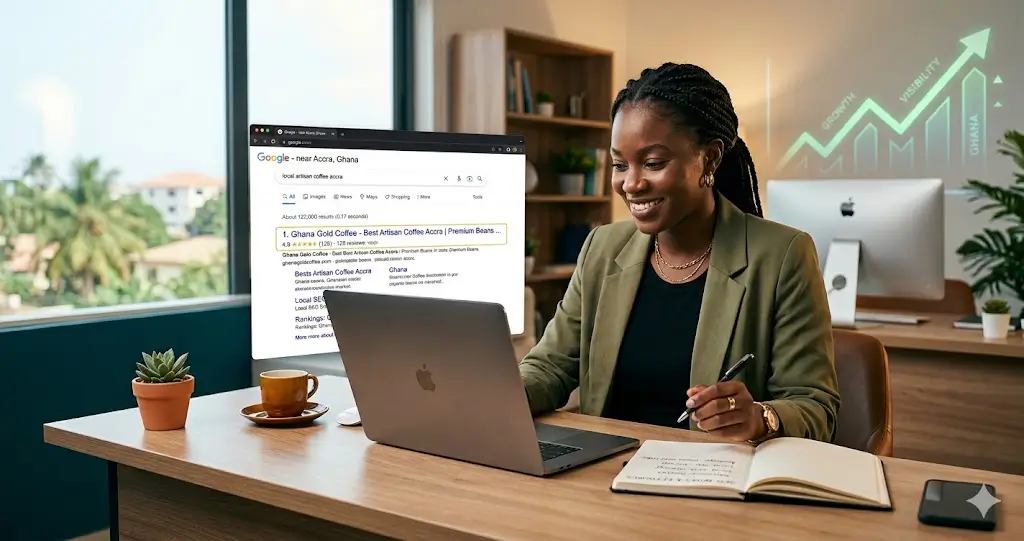
Want more Ghanaian customers to find your business on Google? This practical SEO guide covers everything from keywords to page speed — written for small business owners at every level.
Introduction: Why Google Is the Most Powerful Customer You'll Ever Have
Every day, millions of people across Ghana and West Africa open Google and type in exactly what they're looking for. "Best tailoring shop in Accra." "Where to buy phone accessories in Kumasi." "Affordable catering services near me." These are your potential customers — and right now, they're either finding your business or finding your competitor's.
Search Engine Optimization, or SEO, is simply the process of making sure Google understands what your business does, trusts your website, and shows it to the right people at the right time. It's not a technical dark art. It's not reserved for large corporations with big marketing budgets. It's a set of practical habits and decisions that any business owner can learn and apply — starting today.
In Ghana and across West Africa, SEO is still a significantly underutilised advantage. Most small businesses either have no website at all, or have one that Google can barely find. That means the bar to rank well is lower here than in more saturated markets — which is a genuine opportunity for business owners who take it seriously.
This guide covers the core pillars of website optimization for Google search — from beginner fundamentals to practical intermediate techniques — with examples rooted in the Ghanaian and West African business context.
- Understanding how Google ranks websites
- Keyword research — finding what your customers search for
- On-page SEO — optimizing your content
- Technical SEO — speed, mobile, and structure
- Local SEO — dominating searches in your city
- Content strategy — building long-term search visibility
- Tracking your progress with free tools
How Google Decides Which Websites to Show
Before you can optimize for Google, you need to understand — at a basic level — how it decides which websites to show and in what order. Google uses automated programs called crawlers that visit websites, read their content, and add them to a massive index. When someone searches, Google scans that index and ranks results based on hundreds of signals.
The three things Google cares about most are:
- Relevance — Does your website actually answer what the person searched for? Does the content match the search intent?
- Authority — Does Google trust your website? Are other credible websites linking to yours? How long has your site been around?
- Experience — Is your website fast? Does it work well on mobile? Is the content well-organised and easy to read?
Every SEO action you take is essentially signalling one or more of these three things to Google. Keep this framework in mind as you work through the rest of this guide — it will help you understand why each step matters, not just what to do.
Step 1: Keyword Research — Find Exactly What Your Customers Are Typing
Keywords are the words and phrases people type into Google when looking for a product or service like yours. Keyword research is the process of discovering those phrases — and then making sure your website uses them naturally in the right places.
This is where many Ghanaian business owners make their first mistake: they optimise their website for what they think people search for, rather than what people actually type. The difference matters enormously.
Types of keywords to target:
- Short-tail keywords — broad, high-volume terms like "catering Ghana" or "web design Accra." Competitive but worth including.
- Long-tail keywords — specific, lower-competition phrases like "affordable outdoor catering services in Tema" or "custom kente fabric shop Kumasi." These convert better because the searcher knows exactly what they want.
- Local keywords — location-specific searches like "electrician near Spintex" or "accounting firm East Legon." Crucial for service-based businesses.
- Question keywords — queries phrased as questions like "how to register a business in Ghana" or "where to buy building materials in Takoradi."
Free tools for keyword research:
- Google Search itself — start typing a keyword and see the autocomplete suggestions. These are real searches people make. Scroll to the bottom for "Related searches."
- Google Keyword Planner — free with a Google account. Shows search volume and competition level for any keyword in any country.
- Ubersuggest — free tier available. Gives keyword ideas, search volume estimates, and competitor analysis.
- AnswerThePublic — shows question-based keyword ideas around any topic. Useful for blog content planning.
Practical example for a Ghanaian business: If you run a hair salon in Accra, don't just target "hair salon." Research whether customers search for "natural hair salon Accra," "braiding salon East Legon," "wig installation Accra," or "affordable locs salon Ghana." Each phrase is a potential page on your website and a different customer you can capture.
Image prompt: A close-up of a laptop screen showing Google Keyword Planner with Ghana-specific keyword results for a local business search. A notepad beside the laptop has keyword ideas written down. An African entrepreneur's hand is visible taking notes. Style: clean, editorial lifestyle photography. Warm neutral tones. 1200x800px.
Step 2: On-Page SEO — Optimise Every Page Properly
On-page SEO refers to everything you do directly on your website pages to help Google understand what each page is about. This is the most direct lever you have — and it's entirely within your control.
Page Title (Title Tag)
The page title is the clickable blue headline that appears in Google search results. It's one of the most important on-page SEO elements. Every page on your website should have a unique title that includes your primary keyword and is under 60 characters. Example: "Affordable Hair Braiding Salon in Accra | Radiance Hair Studio"
Meta Description
The short paragraph that appears below the title in search results. It doesn't directly affect rankings but massively affects whether people click. Write a compelling 150–160 character summary that includes your keyword and tells searchers what they'll find. Example: "Professional braiding, locs, and wig installation in Accra. Walk-ins welcome. Book your appointment today at Radiance Hair Studio."
Headings (H1, H2, H3)
Your page should have one H1 heading (the main title on the page itself) that includes your primary keyword. Use H2 and H3 subheadings to organise the rest of the content — they help both Google and human readers navigate. Think of headings like a table of contents for your page.
Content Body
Use your primary keyword naturally throughout the page — in the first paragraph, a few times in the body, and in at least one subheading. Don't stuff keywords unnaturally (Google penalises this). Write for human readers first; Google's algorithms are sophisticated enough to understand context.
Image Alt Text
Every image on your website should have descriptive alt text — a short text description of what the image shows. This helps Google understand your images (it cannot "see" them) and is also important for accessibility. Example: alt="natural hair braiding salon in Accra Ghana" instead of alt="image1.jpg"
Internal Links
Link between pages on your own website where relevant. If you mention your services on a blog post, link to your services page. Internal links help Google discover all your pages and understand how your site is structured.
URL Structure
Keep URLs short, descriptive, and keyword-rich. Use hyphens between words. Example: yourbusiness.com/hair-braiding-accra instead of yourbusiness.com/page?id=42
Image prompt: A laptop screen showing a well-structured website page with visible headings (H1, H2), a clear meta description preview in a browser tab, and a content editor with keyword-highlighted text. Clean, modern web design. African entrepreneur's desk background. Style: editorial digital product photography. Teal and white tones. 1200x800px.
Step 3: Technical SEO — Make Sure Google Can Find and Load Your Site
Technical SEO refers to the behind-the-scenes elements of your website that affect how Google crawls, indexes, and ranks it. You don't need to be a developer to address most of these — but you do need to be aware of them.
Mobile-Friendliness
This is non-negotiable in Ghana and across West Africa. The vast majority of Ghanaian internet users access websites on smartphones. Google uses mobile-first indexing, which means it primarily looks at the mobile version of your site when deciding rankings. If your website looks broken or is difficult to use on a phone, your rankings will suffer significantly. Test your site at search.google.com/test/mobile-friendly — it's free.
Page Speed
Slow websites rank lower and lose visitors fast. In Ghana, where mobile data speeds can vary, page speed is especially critical. According to Google, over 50% of mobile users abandon a page that takes more than 3 seconds to load. Use Google PageSpeed Insights (pagespeed.web.dev) to test your site speed — it's free and gives you a specific list of fixes to implement. Common speed fixes include compressing images, reducing large video files, and using a faster hosting provider.
HTTPS Security
Your website URL should begin with https:// not http://. The "S" stands for secure — it means your site has an SSL certificate and encrypts data between your site and visitors. Google gives a small but real ranking boost to HTTPS sites. More importantly, browsers show a "Not Secure" warning on HTTP sites, which destroys visitor trust. Most hosting providers offer free SSL certificates — enable it if you haven't already.
Sitemap and Robots.txt
A sitemap is an XML file that lists all the pages on your website, helping Google discover and index them. A robots.txt file tells Google which pages it should and shouldn't crawl. If you use WordPress, a plugin like Yoast SEO or Rank Math generates both automatically. Submit your sitemap to Google Search Console to ensure Google knows about all your pages.
No Broken Links
Links on your website that lead to pages that no longer exist (404 errors) frustrate visitors and signal poor site quality to Google. Use a free tool like Broken Link Checker periodically to find and fix these.
Image prompt: A smartphone screen showing a clean, fast-loading Ghanaian business website with a Google PageSpeed score of 90+. The phone is held by an African entrepreneur in a modern office. Style: product lifestyle photography, bright and modern, teal and white colour palette. 1200x800px.
Step 4: Local SEO — Own Your City on Google
For most Ghanaian small businesses, the single highest-value SEO action you can take is optimising for local search. Local SEO is what gets your business appearing when someone in Accra, Kumasi, Takoradi, or Tamale searches for what you offer in their area.
Google Business Profile (Formerly Google My Business)
This is the most impactful free tool available to any local business in Ghana. A Google Business Profile is what populates the map results and the business information panel on the right side of Google when someone searches your business name or a local service. It's completely free to set up and manage.
How to set up and optimise your Google Business Profile:
- Go to business.google.com and create or claim your listing
- Verify your business (Google sends a code to your address or phone)
- Fill in every section completely: business name, category, address, phone, website, opening hours
- Add high-quality photos of your premises, products, and team — businesses with photos get significantly more clicks
- Write a keyword-rich business description (up to 750 characters)
- List your services or products with descriptions and prices where possible
- Collect and respond to customer reviews — more on this below
- Post updates, offers, and photos regularly — Google rewards active profiles
Customer Reviews
Google reviews are one of the most powerful local SEO signals. Businesses with more positive reviews rank higher in local search results and get clicked more often. Don't be shy about asking satisfied customers to leave a Google review — most people are happy to if you make it easy. Create a short link directly to your review page and share it via WhatsApp after a successful transaction.
Local Citations
A local citation is any mention of your business name, address, and phone number (NAP) on another website. Being listed on directories like Jiji Ghana, Ghana Yellow Pages, Jumia Food (for restaurants), and local business directories builds your local SEO authority. Make sure your NAP information is consistent across all listings — inconsistencies confuse Google.
Location Pages on Your Website
If you serve multiple cities or districts, create a dedicated page for each location. A cleaning company serving both Accra and Kumasi should have separate pages optimised for "cleaning services Accra" and "cleaning services Kumasi" — not one generic page trying to target both.
Image prompt: A smartphone screen showing a Google Maps result displaying a Ghanaian business profile — a restaurant or retail shop — with a 4.8 star rating, photos, and a "Directions" button visible. Warm, inviting business storefront photo in the profile. Style: clean product lifestyle photography, warm amber tones. 1200x800px.
Step 5: Content Strategy — Build Long-Term Visibility with Helpful Content
One of the most powerful long-term SEO strategies is consistently publishing high-quality, helpful content that your target audience is searching for. This is what a blog is for — and it's why businesses that blog regularly get significantly more organic search traffic than those that don't.
Every blog post you publish is a new page Google can index. Every page is a new keyword you can rank for. Every keyword is a new group of potential customers who can discover your business. Over time, this compounds dramatically.
Content ideas for Ghanaian businesses by category:
- Import business: "How to Import Electronics from China to Ghana," "Ghana Customs Duties Explained," "Best Cargo Companies from China to Accra"
- Fashion and retail: "Where to Buy Authentic Kente Fabric in Kumasi," "How to Style Ankara for Office Wear," "Best Markets for Fabric in Accra"
- Food and catering: "How to Plan a Ghanaian Traditional Wedding Menu," "Best Caterers in Accra for Corporate Events," "How Much Does Event Catering Cost in Ghana?"
- Tech and services: "How to Register Your Business Online in Ghana," "Best Payment Solutions for Small Businesses in Ghana," "How to Build a Website for Your Ghanaian Business"
- Real estate: "Average House Rental Prices in East Legon 2026," "How to Rent an Apartment in Accra as a First Timer," "Best Neighbourhoods in Accra for Families"
Content quality checklist:
- Does the article fully answer the question implied by the keyword?
- Is it at least 800–1,200 words for informational posts?
- Does it use relevant images with proper alt text?
- Does it link to other useful pages on your site?
- Is the writing clear, practical, and free of jargon?
- Is the primary keyword used naturally in the title, first paragraph, and at least one subheading?
Aim to publish at least one new piece of quality content per week. Consistency matters more than volume — a steady stream of good content outperforms sporadic bursts of many average posts.
Image prompt: An African entrepreneur sitting at a bright co-working desk, writing a blog post on a laptop. The screen shows a partially written article with keyword-rich headings. A content calendar is visible on a notebook beside the laptop. Style: warm, creative lifestyle photography. Amber and teal accent tones. 1200x800px.
Step 6: Track Your Progress — Free Tools You Need to Use
SEO without tracking is guesswork. These free Google tools tell you exactly how your website is performing in search — and where to focus your efforts next.
Google Search Console
This is the most important SEO tool you can use — and it's completely free. Google Search Console tells you: which keywords your site is ranking for, how many people are clicking through to your site from Google, which pages get the most impressions, any technical errors Google found on your site, and whether your pages are being indexed properly. Set it up at search.google.com/search-console and verify your website. Check it at least once a week.
Google Analytics 4
While Search Console shows what happens on Google, Analytics shows what happens on your website after people arrive. It tells you how many visitors you're getting, where they come from, which pages they view, how long they stay, and where they leave. Set up at analytics.google.com and connect it to your website using your GA4 tracking code.
Google PageSpeed Insights
Test your website speed and get a specific list of improvements at pagespeed.web.dev. Run this monthly and work through the recommendations systematically.
Ubersuggest (Free Tier)
Track your keyword rankings, see which pages are performing, and identify new keyword opportunities. The free tier offers limited daily checks but is more than enough for most small businesses starting out.
Image prompt: A laptop screen displaying the Google Search Console dashboard with a Ghana-based website showing keyword impressions and click data in a clean chart. An African entrepreneur reviews the data with a notebook beside them. Style: clean, analytical editorial photography. Navy and teal tones. 1200x800px.
Quick-Win SEO Checklist: Where to Start This Week
- Set up or claim your Google Business Profile and complete every section
- Install Google Search Console and submit your sitemap
- Test your website on mobile using Google's mobile-friendly test
- Check your site speed on PageSpeed Insights and fix image sizes
- Ensure your site URL starts with https://
- Write a unique title tag and meta description for every key page
- Add alt text to all images on your website
- Research 10 keywords your customers are searching and map them to pages
- Ask your 5 most recent satisfied customers for a Google review
- Publish your first SEO-optimised blog post this week
Conclusion: SEO Is a Long Game — But the Rewards Are Worth It
Here's the honest truth about SEO: it takes time. Unlike paid advertising where results appear the moment you spend money, SEO builds gradually — typically taking 3–6 months before you see significant movement in rankings. But unlike paid ads, the results compound and last. A well-optimised page can bring in customers for years without ongoing cost.
For Ghanaian and West African businesses, this is an enormous opportunity. Most of your competitors have not yet invested seriously in SEO. The market is less saturated, the competition for keywords is lower, and the rewards for early movers are higher.
Start with the quick wins on the checklist above. Set up your Google Business Profile. Fix your mobile experience. Publish one good piece of content. Then build from there, one step at a time. Six months from now, you'll look back on this as one of the best investments you made in your business.
Have questions about SEO for your specific business or industry? Drop a comment below — we're here to help you rank.